|
| Sunset at Puerto Escondio |
We left early the next morning, April 10, 2013, travelling
from Aqua Verde to Puerto Escondido.
This was a trip of about 23 miles. (25 deg – 48.740’N by 111 deg –
18.077’W)
The day was fair, still very
cold (we were wrapped up in fleece and toboggans) with some haze, light winds,
and 7 to 10 knots right on the nose from the North; we therefore motorsailed all
the way.
Puerto Escondido is a major marina located about 14 miles
south of the City of Loreta. Puerto Escondido is one of the Baja’s most
protected harbors, being almost completely landlocked with the exception of a
200 foot wide entrance channel. The
inner harbor can easily hold over 150 boats and is often used as a hurricane
hole during the summer months. Last year
Edie and I endured Hurricane Paul in Puerto Escondido and did very well. The hurricane did not totally develop and
the huge mountain range, Sierra Gigantia, helped steer it away from us; we
couldn’t have found a more secure location.
Puerto Escondido is made up of three separate
anchorages. There is a fairly deep
anchorage located just outside the enclosed harbor and it is very popular with
cruisers based on the protection it offers, and the very small fee for anchoring there. This outside
anchorage is called the “Waiting Room”.
Just past the Waiting Room is the entrance to the main inner
harbor which is fairly shallow and always causes me to squench up a little bit
when I go through the shallow part. We
had a saying in Florida
that there were only two types of sailors, those who admit to having run
aground and liars. I have run aground
before, but I don’t like the sound that it makes and I avoid it whenever I can; and I think squenching up really does help a lot.
Immediately inside the entrance to the main harbor, and to
the west is the third anchorage called the Ellipse.
 |
| Main harbor, Puerto Escondido |
|
The Ellipse is too close quartered for me and
my boat.
The turning radii are too tight
and the distances between moorings is not enough to accommodate Milagro, so we
go straight to the main harbor where we have all the room to roam.
As I had said, I have been to Puerto Escondido before, and
was looking forward to the morning net,where they have a really good weather
man, and the last subject of discussion on the net is “News, Trivia, and
Jokes”. I have never heard that category
at any other net I have listen to. It
was really fun.
As we were coming into the main harbor we got a call on the
VHF radio from a boat anchored just inside the entrance. The boat’s name is Seychelles,
and the owners were some of our dearest friends from Alaska, John and Niki Stone. It was a delight to hear from them, and a
total surprise to find them here. We
made arrangements to eat at Pedro’s the next night as they had ready made plans
for that night.
 |
| Stunning mountain view from habor |
We got the paperwork together along with our computers,
launched the dingy and headed out to the office for check-in and to Pedro’s Restaurant
for a beer and the free internet.
We had
been at sea for days and out of contact with the world.
We both needed to catch up, check our emails,
and talk to family, and doing that with a cold beer in your hand makes it even
sweeter.
It is sort of funny here, the
internet connection through either the restaurant or the marina office is
quite good but there is no cell phone service at all.
At times, when all conditions are just right,
you can even Skype, and therefore, I have a chance to speak to Edie back in North Carolina.
It always brightens my day when I can hear
her voice, even if it crackles and breaks up in a weak internet
connection.
But on this night it was an
extremely good connection and we were able to chat.
I had installed two 42 inch long, blue LED light strips, one
on each side of the top of the mast. The
purpose of these light strips was to be able to find our boat when we were in a
crowded anchorage. People have come to
know me by my bright blue glowing anchor lights, and therefore we had no
problem finding our way back to Milagro on a moonless, totally dark
evening, even after a couple of beers
and great chicken sandwichs under our belts.
The next day was spent doing some house work, cleaning up
the boat and resting some. Sharon
was writing, as she so often does; maybe this will be another book. I told her she could make me any kind of
dashing and hardy sea captain that she wanted to, that I wouldn’t mind if gave
me some snappy sea faring name. She reminded me that this was non-fiction
adventure and would require that she tell the truth. I still wonder what she meant by that.
We had decided to rent a car and visit Loreta the next day. Loreta is a really neat historic little town,
and a whole day can be spent just walking around and looking. There are great places to eat and all sorts
of shopping in case you are so inclined.
The car rental companies will bring the car to Puerto Escondido and we
are allowed to leave the keys with the office for the company to pick the
car up later. We needed a few things
from the tienda anyway, and the garbage needed to go out, so I dingied over to
the office to make arrangements for the car.
John and Niki came by in their dingy to visit for a
while. It’s always a pleasure to spend time with them. John is so funny, you can
never tell whether he is telling you is the truth, or whether he is just
putting you on, and it is actually a lot of fun trying to figure out which it
is. John is also very smart and knows
a huge amount about boats. At one time
he was the Harbor Master in a big marina in Alaska, and has been around boats for a long
time. I have found that taking advice
from John is a good idea and I listen very closely. I was telling him about the trouble I was
having with my generator, that I thought it was the thermostat that was causing
the problem, and was about to take the heat exchanger off. He doubted the thermostat going bad, and
warned that the gaskets might be a problem on re-installation. I better put that off till I get to La Paz. We confirmed that we would do dinner at Pedro’s tonight, and
after a very pleasant visit, John and Niki dinghyed away.
We were low on water and made arrangements to go over to
the fuel dock to fill up our tanks.
There were other boats that were tied up to the dock, and it took
several hours for the dock to free up so we could go in. There was some problem with the fuel pumps,
and the other two boats were waiting for fuel.
Finally it was our turn, and we pulled the anchor, and headed for the
fuel dock. After another spectacular
landing, without a single mark on the boat, Sharon or me, we filled the water tanks to
the brim. Oh boy, we can take another
shower today.
At about dark we met John and Niki at Pedro’s Restaurant
and had another great visit. I tried
Pedro’s pizza, and I will say again, I have not had a good pizza since I’ve
been in Mexico. It was big, and it had a lot of stuff on it, and
Sharon was looking forward to cold pizza for
breakfast, but it was not the best pizza I have ever had, even in Mexico. John and Niki had planned to leave the next day,
but when they found out that I had rented a car and was going to spend the next
day in Loreta, they were willing to put off their departure for a day and join
us.
We met the car rental lady at the office at 9:00 in the
morning just had been arranged. She had
a lot of fun talking with the gringos.
She was new to Loreta, and although she spoke English very well, she had
spent very little time around gringos where she lived on the mainland. We invited her to ride back to Loreta and
save her company the trouble of having to pick her up. John kidded her unmercifully all the way to
Loreta, and she seemed to enjoy every minute of it.
 |
| Larry, Sharon, John and Niki |
Loreta looked familiar to me, having been here just last
year, and we took a route similar to the one we took last time, starting with
breakfast in a typical outdoor Mexican fashion.
I was hungry and it was good.
During breakfast who should wander in but our neighbors
across the dock from us in La Paz,
from a boat named “True Love”. Its fun to run
into people like that that you know; we weren’t really all that close to them
in La Paz, but when you run into them in another place, it was like we were
best friends. We then wandered around
city hall, up to the historic Jesuit Mission that had originally established
the town in 1697. We went through the
museum, and watched Loreto develop through the ages.

We then found the tree canopied street with all the amazing
Mexican art and crafts, and spent the better part of the afternoon just
meandering through the amazing shops.
That’s the good thing about living on a boat; you can’t buy all those
arst and crafty things 'cause you don’t have the room to keep them.
So this type of shopping has little to no
risk to the purse.
 |
| Cave Paintings |
After visiting the Malecon, and hiking around the dinghy
marina, we were all beginning to tire.
John and Niki had taken a road trip with a historic guide the last time
they were in Loreta more than a year ago, and it was amazing all that the guide
had to tell them. They could still remember the roads they had taken, and
wanted us to see them.
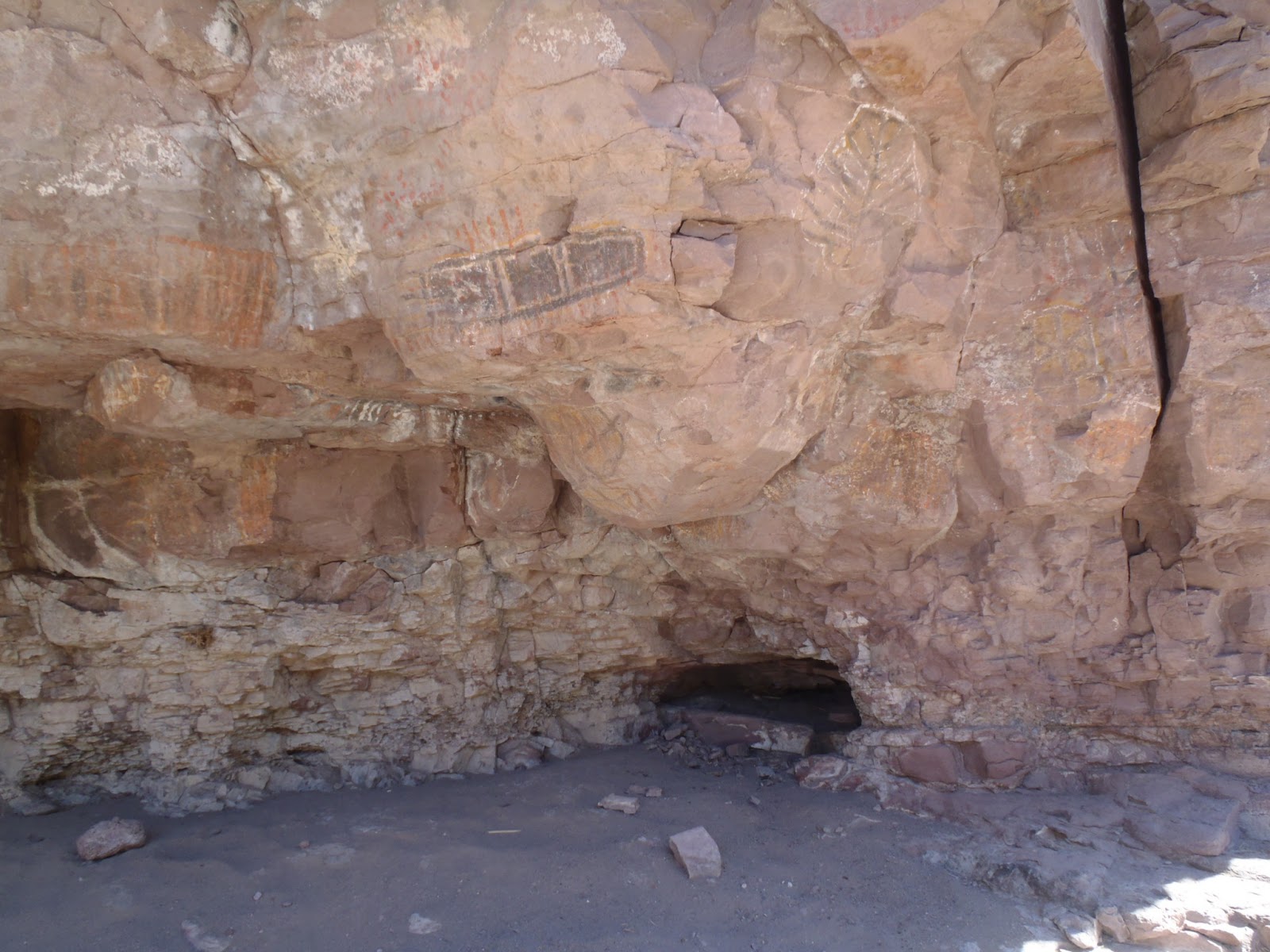
We turned off the
main road and immediately started up into the mountains.
It was an incredibly curvy road and we made
our way along slowly.
Suddenly Niki
says, pull over, there it is.
Niki had
remembered from her tour that up this creek bed there were old caves, and inside
the caves were paintings from a thousand years before.
They of course were fenced off, and protected
from the hands of the public, but we could peer inside and see figures on the
wall:
graphic figures, designs, and rectangular
images.
These were not pictures of
animals, or space aliens like regular cave paintings, but were designs
instead.
Amazing.
We then hiked on up the creek, which was most unusual for
the Mexican desert, because running water is almost unheard of. We followed the creek for probably a mile, as
long as my ankle would allow, and it was obvious the amount of washed away
trees and debris was from the huge storm that had hit here about a year
ago. That storm was Hurricane Paul, and
as I had said before, we had been here for that storm. You could see how savagely the earth had been
eroded and the vegetation swept away Even a year later, the devastation was
obvious.

We continued to drive up into the mountains looking for
another old mission that had many years ago been associated with the original
mission down town.
John had dubbed it as
a sub-mission, and I kept trying to make a religious joke out of sub-mission but never got it just right.
We did find the mission, and it was beautiful,
well kept, and worth the trouble.
The road up to the mission made the drive particularly interesting,
because even though Hurricane Paul had hit over a year ago, this road was still
washed out and in places treacherous.
There were places where the road was unpaved, rough, rocky, only one car
width wide and with enormous drop offs on each side. But the ride was exciting, beautiful and well
worth the time spent exploring the back woods. At the end of the day, we were all tired, and pleasantly so,
we all went back to our boats, and made early nights of it. When we woke the next morning John and Niki had left.
Sharon and I had agreed before leaving La Paz that we would make the trip back
an overnight passage, very much the way Edie and I did it last year. This was a good exercise to see how well we
would do watches, and how we would sleep under way.
On April 13, 2012, we left Puerto Escondido, on our way back
to La Paz. The distance back to La Paz was about 128 miles, and we estimated
that it would take us approximately 24 hours to complete it. The wind was very light, and right on our
nose. It didn’t make any difference
which way we turned the boat as we maneuvered around the rocks, the
pinnacles, and the islands on our way back: the wind was always right on our
nose which made sailing impossible. We ended up motoring for the
entire distance.
 The island came into sight just as the sun
was rising after the third night. Even
from very far away one could tell that this was a rugged - very rugged - piece of landscape. There were steep mountains rising straight
out of the water, and while I am not a good judge of heights these mountains were
really up there. In the early morning
light it was a spooky looking place, with a mist that shrouded the mountain
and conveyed a great mystery about what we were getting into. According to the cruising guide one should keep good distance off the shore due to numerous submerged rocks and pinnacles
that would barely show above the surface of the water. There were also the hazards of fishing nets and
long lines that are used by the fishermen in the waters surrounding the island
for many miles out. The nets and lines
are frequent propeller, keel, stabilizer, and rudder foulers. Of course the abundance of this type of gear
illustrates the excellent fishing found around the island. Actually Isabel is
made up of several islands in close proximity with one another, but the main
island is the only one that could be landed on or explored. We had been advised that due to the
relatively poor and rocky bottom, and the fact that there is little protection
from steep winds, that anchoring off Isabel is best suited in calm to light conditions. The island
has a bad reputation for swallowing anchors, particularly in the southern bay due to the numerous
reefs and underwater rock formations. It
had been recommended that due to the possibility of sticking the anchor that I
should consider the use of a trip line and buoy on the anchor. I had all that I needed to set up such a
system but I had never used one before.
It seemed simple enough, just one more thing that needed to be
coordinated when dropping the anchor. If
the anchor does become stuck, or bound, the trip line can be useful in getting
the anchor up.
The island came into sight just as the sun
was rising after the third night. Even
from very far away one could tell that this was a rugged - very rugged - piece of landscape. There were steep mountains rising straight
out of the water, and while I am not a good judge of heights these mountains were
really up there. In the early morning
light it was a spooky looking place, with a mist that shrouded the mountain
and conveyed a great mystery about what we were getting into. According to the cruising guide one should keep good distance off the shore due to numerous submerged rocks and pinnacles
that would barely show above the surface of the water. There were also the hazards of fishing nets and
long lines that are used by the fishermen in the waters surrounding the island
for many miles out. The nets and lines
are frequent propeller, keel, stabilizer, and rudder foulers. Of course the abundance of this type of gear
illustrates the excellent fishing found around the island. Actually Isabel is
made up of several islands in close proximity with one another, but the main
island is the only one that could be landed on or explored. We had been advised that due to the
relatively poor and rocky bottom, and the fact that there is little protection
from steep winds, that anchoring off Isabel is best suited in calm to light conditions. The island
has a bad reputation for swallowing anchors, particularly in the southern bay due to the numerous
reefs and underwater rock formations. It
had been recommended that due to the possibility of sticking the anchor that I
should consider the use of a trip line and buoy on the anchor. I had all that I needed to set up such a
system but I had never used one before.
It seemed simple enough, just one more thing that needed to be
coordinated when dropping the anchor. If
the anchor does become stuck, or bound, the trip line can be useful in getting
the anchor up.